Bargain Opal - The Internet's Best Sites

Black Opal Auctions

The cheapest form of opals are known as doublets and triplets. So what are they? Breaking away from convention, OpalAuctions.com has a wide variety of US$1 No Reserve opal bargains ranging from jewelry, black opal, boulder and coober pedy opal to opal art and various gemstones.
doublet opal triplet opals doublet triplet comparison diagram
this is a doublet
this is a triplet
this diagram illustrates the difference between the two

Triplet

Similar to a doublet, but has three pieces sandwiched together, with a thin piece of precious opal cemented to a backing and a clear quartz cap placed on top to protect and bring out the colour of the opal.

Opal Auctions stocks a range of triplets

Doublet

Opal doublets, as the name suggest, is a thin layer of precious opal cemented onto a backing, usually a piece of black common opal or ironstone. Produced because the opal is too thin to produce a solid stone, doublets are a cheap and inexpensive way to buy a colourful piece of precious opal without the cost involved of a solid.

What is Opal?

Science has told us this about opal:

CHEMISTRY: SiO2 . nH2O. Water usually 6 to 10% in precious opal, can be as high as 21%

CRYSTALLOGRAPHY: Amorphous

REFRACTIVE INDEX: 1.44 - 1.47

HARDNESS: 5.5 - 6.5

SPECIFIC GRAVITY: 1.99 - 2.25

CLEAVAGE: None

HEAT SENSITIVE: Varies

The word evolved from the Greek word "opallus" meaning to see a change in colour. Later the latin word "opalus" came to mean precious stone.

Opals stand in a class by itself. More than any other gem, each opal is distinctly an individual. No other stone has as rich and varied folklore. Opals are so unique they have their own descriptive vocabulary. They are the most delicate gems that are commonly worn.

Opal's fire was long thought to be the result of iridescence. However, with the advent of scanning electron microscopes, we now know that it is a result of diffraction.

Opal is an amorphous form of silica, (SiO2.nH2O) chemically similar to quartz, (SiO2) but containing 3% to 21% water within the mineral structure. Gem grade opals are usually 6% to 10% water content.

Opal is a sedimentary stone. Under proper conditions, water percolates through the earth, becoming rich in dissolved silicates. When it enters a cavity, the silicates are deposited as tiny spheres. If they are uniform in size and shape, they will diffract light. If they are random in shape and arrangement, we have common opal.

Volcanic ash gives black opal its color, but inclusions have nothing to do with the play of color. That is due entirely to the tiny spheres. They must be smaller than 1500 angstroms for blue and violet colors, but no larger than 3500 angstroms to produce oranges and reds. To put that in perspective, 20,000 spheres are about the size of the period at the end of this sentence.

Opal grows by filling in cavities, regardless of their shape. Hence, we have many pseudomorphs, materials with shapes that are unrelated to the chemical content. The most common are opalized wood and seashells.

source: http://www.gemsociety.org


Opal History

During the Cretaceous period (65-140 million years ago) deserts were an inland sea teeming with life. The sea gradually receded laying the foundation of silica that would form the opal of today. During the mid-tertiary period, changes in the earth’s climate caused quantities of soluble silica to be released from the sediment, finding its way down through cracks and faults, eventually hardening over time. This hardening continued to form common and precious opal.

The vivid array of colour in the opal is from the uniform alignment of the silica particles. The size of the particles determines the colour as light refracts through it.Unlike many other gemstones, opal doesn’t occur in lengthy veins or concentrations. Instead, small clusters may be spread over a vast area and divided into precious or gem quality and common. Opal is found in many varieties, but precious opal represents only a small percentage of the total mined.

It is estimated that between 95 and 99% of the worlds most precious opal is mined in Australia. Several unique regions of Australia specialise in different types of opal, from Coober Pedy's white and crystal opal in South Australia, through to the home of black opal, Lightning Ridge in New South Wales, up to the infamous Hayricks and Hammond's fields in northern Queensland for the boulder variety.

AUSTRALIAN SEDIMENTARY OPAL
– WHY IS AUSTRALIA UNIQUE?

David Horton, Managing Director, Opal Horizon Limited

View Full Geographical Paper (PDF FORMAT - requires Adobe Reader)

ABSTRACT

Australia currently produces about 95 per cent of the world’s precious opal from widely scattered fields throughout central Australia. No other country on Earth has such an abundance of this rare precious gemstone.

The sedimentary opal deposits of central Australia occur along generally flat-lying horizontallayers within 30 metres of the earth’s surface. They are a product of a unique set of geological events which occurred over a 100 million year period. These events can be summarised as follows:

1. Between about 122 million years ago (Ma) and 91 Ma, central Australia was covered by a vast shallow epicontinental sea. The sedimentary rocks which were deposited in this sea were derived from volcanic rocks and were organic-rich. These formed the principal host rocks for opal deposits in central Australia.

2. Following surface exposure through lowering of the sea level, these host rocks were subject to a prolonged sub-tropical weathering regime until about 40 Ma. Central Australia probably looked not unlike today’s Amazon Basin. During this time, the water table was close to the surface and was acidic releasing silica and iron from weathering of the host rocks.

3. The climate became more arid from about 40 Ma and, as a result, water table levels gradually lowered and the groundwater became alkaline. Mild tectonism at 24 Ma gave rise to subtle extremely long wavelength surface folds which facilitated both lateral and vertical migration under arid conditions of the earlier-released silica. Opal was preserved in the weathered profiles beneath the crests of the developing surface folds as water tables here lowered more rapidly due to tectonic uplift. Siliceous cap rocks discouraged erosion.

4. Over the last 10 million years, dissection and scarp erosion exposed the weathering profiles containing the opal.

Geologists believe that the volume of gems that have been produced over the past 150 years in Australia is but a minute fraction of the amount yet to be discovered.


Affordable Opals at your Fingertips

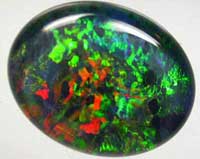
Black Opals are known to be the Most Beautiful Gemstones on earth.

A solid Black Opal Stone is  natural and has not in any way been altered.
Some natural solid black Opals have natural inclusions which also can enhance their beauty.
Black Opals can also sit on dark potch or grey Potch.  Sometimes they may also sit on
potch with small sandpits in their back but don't be discourage by it as this can be your
security that this is a genuine natural solid Black Opal.

Black Opals can be judged by their colour, brilliance and the colour play.

Prices vary from the different variety of Opals available.

For example there are light opals from Coober Pedy that are affordale in price but then of
course price are determined by the colour play.

The best thing to do is get as much information from books available on Opals.
Click on on auction sites that specialise in Opals.  They also auction books on
Opals.

Opal Auction sites are a great means of  acquiring Opals at very affordable prices.
Check out www.opalauctions.com they have their own site.  They do not charge listing fee.
The sellers on this auction site are miners/wholesalers and hobbyists.
Miners/wholesalers list their Opals on the site which does not involve any middleman,
therefore you can be assured of good quality  Opals.

Opals on the auction site are offered by categories.

Categories such as Black Opals from Lightning Ridge New South Wales, Boulder Opals from Quilpie in
Queensland, Coober Pedy Opals from South Australia, Koroit Opals, Yowah Opals

With the Opal Auction sites you can view the photo, size and carat weight is also given.
You can ask sellers questions about the opal on auction and they are only too willing to help you.

Auction sites also offer Technical support if you have problems logging in or you have problem placing your bids.

With the Internet now dominating the whole world, there's no doubt the world is getting smaller with
the emergence of selling merchandise on the internet.

Variety of Opals are now available through the auctions sites and are now more affordable.

Opals are more easily accessed and you can be anywhere around the world and buy your Opals on the Net.

With the opalauctions.com site, Opals are given the exposure they deserve considering they're the most
beautiful Gem in the World.

The Opal Plus Network

Buying Opals Online Sites Information Sites
OPALAUCTIONS.COM - World's largest opal and gemstone specific auction site Bargain Opals - Where to find the best opal deals on the net
OpalPlus.com - Opal Plus's original site - company info, information for Japanese Buyers What is opal? - Scientific analysis
  Opal Blog
  Opal Information
  Opale Noire Opale De Boulder